
Legal Scholars

6 articles in this category (Including both blog posts and archived content)

Quote by Timothy Dwight
Second Amendment quote
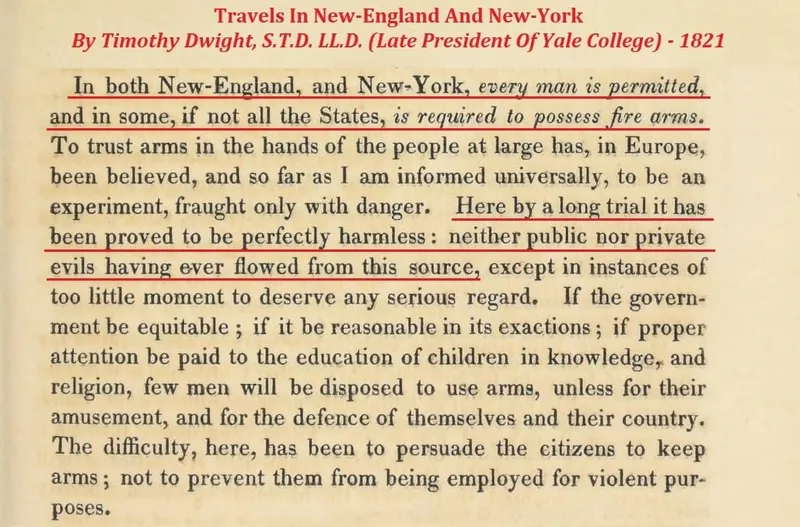
""In both New-England, and New-York, every man is permitted, and in some, if not all the States, is required to possess fire arms. To trust arms in the hands of the people at large has, in Europe, been believed, and so far as I am informed universally, to be an experiment, fraught only with danger. Here by a long trial it has been proved to be perfectly harmless: neither public nor private evils having ever flowed from this source, except in instances of too little moment to deserve any serious regard.""

— Timothy Dwight

Timothy Dwight, S.T.D. LL.D. (Late President Of Yale College), Travels In New-England And New-York, 1821

Quote by Timothy Dwight on new england arms experience
Read More →
Quote by James Burgh
Second Amendment quote
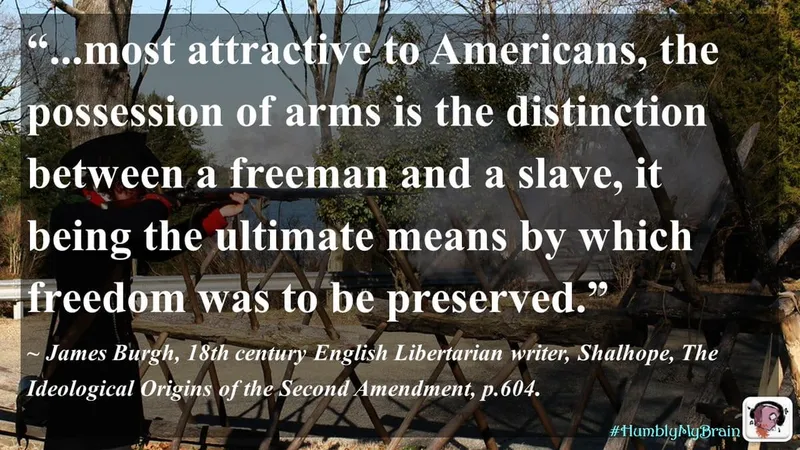
""...most attractive to Americans, the possession of arms is the distinction between a freeman and a slave, it being the ultimate means by which freedom was to be preserved.""

— James Burgh

James Burgh, 18th century English Libertarian writer, Shalhope, The Ideological Origins of the Second Amendment, p.604

Quote by James Burgh on freeman vs slave

Read More →
Quote by Chief Justice Parsons
Second Amendment quote
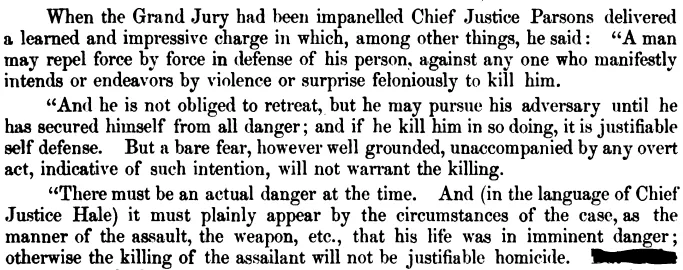
""A man may repel force by force in defense of his person, against any one who manifestly intends or endeavors by violence or surprise feloniously to kill him. And he is not obliged to retreat, but he may pursue his adversary until he has secured himself from all danger; and if he kill him in so doing, it is justifiable self defense.""

— Chief Justice Parsons

Chief Justice Parsons, Grand Jury charge

Quote by Chief Justice Parsons on self defense law

Read More →
Quote by Richard Hildreth
Second Amendment quote
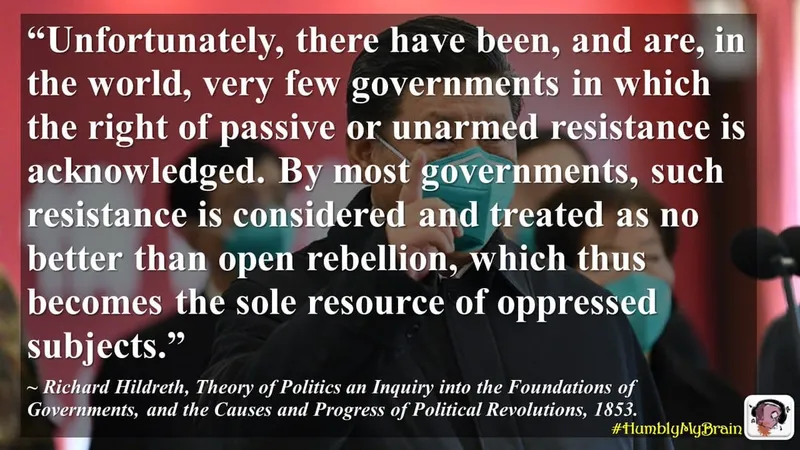
""Unfortunately, there have been, and are, in the world, very few governments in which the right of passive or unarmed resistance is acknowledged. By most governments, such resistance is considered and treated as no better than open rebellion, which thus becomes the sole resource of oppressed subjects.""

— Richard Hildreth

Richard Hildreth, Theory of Politics an Inquiry into the Foundations of Governments, and the Causes and Progress of Political Revolutions, 1853

Quote by Richard Hildreth on unarmed resistance

Read More →
Quote by Sir William Blackstone
Second Amendment quote
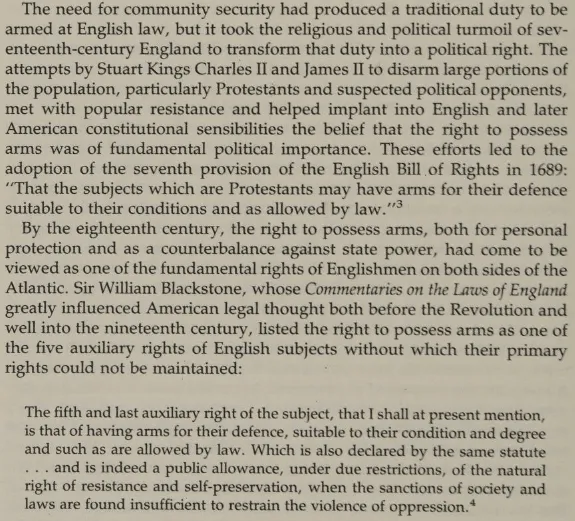
""By the eighteenth century, the right to possess arms, both for personal protection and as a counterbalance against state power, had come to be viewed as one of the fundamental rights of Englishmen on both sides of the Atlantic. Sir William Blackstone, whose Commentaries on the Laws of England greatly influenced American legal thought both before the Revolution and well into the nineteenth century, listed the right to possess arms as one of the five auxiliary rights of English subjects without which their primary rights could not be maintained: 'The fifth and last auxiliary right of the subject, that I shall at present mention, is that of having arms for their defence, suitable to their condition and degree and such as are allowed by law. Which is also declared by the same statute... and is indeed a public allowance, under due restrictions, of the natural right of resistance and self-preservation, when the sanctions of society and laws are found insufficient to restrain the violence of oppression.'""

— Sir William Blackstone

Sir William Blackstone, Commentaries on the Laws of England

Quote by Sir William Blackstone on auxiliary rights

Read More →
Quote by Thomas M. Cooley
Second Amendment quote
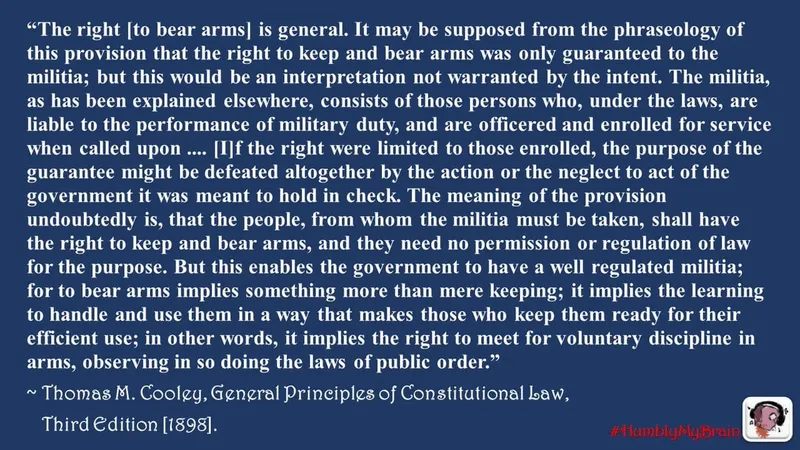
""The right [to bear arms] is general. It may be supposed from the phraseology of this provision that the right to keep and bear arms was only guaranteed to the militia; but this would be an interpretation not warranted by the intent. The militia, as has been explained elsewhere, consists of those persons who, under the laws, are liable to the performance of military duty, and are officered and enrolled for service when called upon.... [I]f the right were limited to those enrolled, the purpose of the guarantee might be defeated altogether by the action or the neglect to act of the government it was meant to hold in check. The meaning of the provision undoubtedly is, that the people, from whom the militia must be taken, shall have the right to keep and bear arms, and they need no permission or regulation of law for the purpose.""

— Thomas M. Cooley

Thomas M. Cooley, General Principles of Constitutional Law, Third Edition [1898]

Quote by Thomas M. Cooley on individual right interpretation

Read More →

Page 1 of 1

Showing 1-6 of 6 posts