

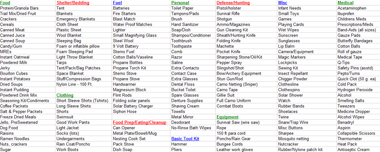
The Master Evacuation Kit List
This is the second post in a series, the first post covers Evacuation Preparedness basics and can be read here. Previously, I briefly introduced the Mother of all Evacuation Lists. This list is the result of reviewing well over 100 Bug Out Bag, 72 Hour Kit and G.O.O.D. bag lists and building a master list from them. The new master list can be found here. The link will take you to a Google Spreadsheet which is what we’ll be using for now. I’m hoping to get feedback from readers on other items that should be included which I’ll add to the list. By the end of the series I’ll post an excel file that you can download and store or share. In the meantime, feel free to share the link to the spreadsheet. In this post we’ll start going over the list and get familiar with it.
Categories
Everything on the list is broken down into categories. We have Food, Shelter/Bedding, Fuel, Personal, Defense/Hunting, Misc, Medical, Documents/Money, Address/Phone Lists, Communication, Navigation, Info Carsds, Nuclear/Bio/Chem, Don’t Forget List, Fishing Equipment, Light, Books, Winter Clothes, Automotive, Water, Food Prep/Eating/Cleanup, Tool Kit, Equipment and Clothing. Over the next few posts we’ll break each of these categories down and discuss the types of items that you might include in your Evac Kits from these categories.
Organization
When I put this list together the goal was to provide an all-inclusive list that each person could pare down to what made sense for themselves. There will likely be many things on this list that you don’t feel a need for. You shouldn’t feel like you have to go buy everything on the list or anything like that. The idea is that you can reliably make a personalized list for yourself from this one and know that most everything has been considered - by over 100 people who felt that their list was good enough! Due to this goal, this list is organized a bit differently than others that you’ll find. One of the first things you might notice is that there are no quantities given. The reason for this is that the quantity needed/desired can be very different from person to person and you should consider the item and multiple scenarios and determine how much you need. The next thing you might notice is that many lists have a prioritization system - this one does not. You will need to decide for yourself how much of a priority each item should have. There is also no indication as to which container things should go in. We’ll talk about containerizing in a later post, but some of the items on the list should go into your BOB, others should be stored in a category container such as Fishing Equipment, others might be in a rifle case containing a rifle and cleaning equipment. This is also something you’ll need to decide for yourself. There are also a few categories that may not make much sense - Address/Phone Lists is a list that you keep in your BOB that contains the phone and address of several important contacts you may need while you’re evacuated. We’ll be providing a list you can fill out and print in a later post. There is also a ‘Don’t Forget List’, this is a list of things that you aren’t going to keep pre-staged but that you must not forget when you are rushing around trying to evacuate. It’s a customized check list for before you leave the house - we’ll be providing a downloadable worksheet later in the series. Finally, the Info Card contains vital information for a family member. Each family member should have one in their BOB with the parents/guardians having a copy of all them in their BOB or Document Case. We’ll also be providing a downloadable worksheet for this. Several of these lists are such that you’ll need to update them on a regular basis, like every 6 months. Over the next few posts we’ll be going through the items in the categories and discussing their use and why they’re included. Once we’ve done that, we’ll discuss Kit Inventories - reviewing our kits on a regular basis to make sure they’re ready to go. The next post in this series is here: Evacuation Preparedness List Review Part 1